

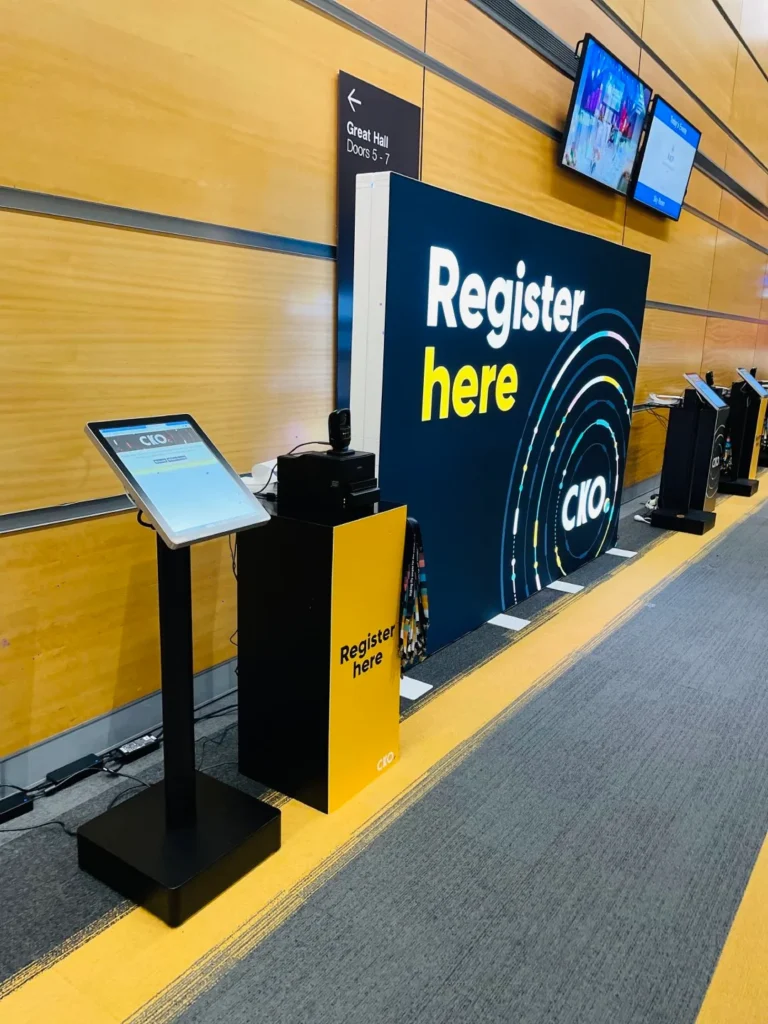
For most conferences and exhibitions, a printed QR code is the best event badge technology. It costs almost nothing, prints on demand at the registration desk and scans with a phone or a handheld scanner. Choose RFID or NFC badges when you need to track attendees room by room, open doors hands-free or support cashless payments. Choose a classic barcode only when your existing scanners and software already read it.
This guide compares QR code vs RFID event badges, with barcodes in the middle, so you can pick the right one for your event size, budget and data needs.
QR code vs barcode vs RFID at a glance
QR code | Barcode (1D) | RFID / NFC | |
|---|---|---|---|
How it is read | Camera or imager scans the printed code | Laser or imager scans a printed line pattern | Radio signal reads a chip inside the badge |
Line of sight needed | Yes | Yes | No |
Cost per badge | Lowest: printed with the badge | Lowest: printed with the badge | Higher: a chip is built into each badge |
Print on site | Yes, on a thermal badge printer | Yes | Chip badges are usually pre-encoded, or printed and encoded on a compatible printer |
Data it holds | A link or an ID, a few hundred characters or more | A short ID number | A short ID, or more on some chips |
Scan speed | Fast, but depends on print quality and angle | Fast, but depends on print quality and angle | Fastest: a tap or a pass-by |
Works with a phone | Yes, any phone camera | No, needs a scanner | NFC only, and phone support varies by model |
Best for | Check-in, lead capture, session scans | Simple check-in on older systems | Access control, session tracking, cashless use |
What is a QR code event badge?
A QR code badge carries a printed square code that holds an attendee ID or a link. A phone camera or a handheld scanner reads it, and the registration system matches the ID to the guest record. Because the code is printed, the badge printer makes it at the moment of check-in. No pre-encoded stock is needed.
Strengths:
- Lowest cost, because the code costs nothing extra to print.
- Works on guests’ own phones, so exhibitors can scan leads without extra hardware.
- Printed on demand, so walk-in guests get a valid badge in seconds.
Limits:
- The scanner needs a clear view of the code. A bent badge, glare or a lanyard that flips the badge backwards slows the scan.
- A printed code can be photographed and shared, so it is weaker for secure access.
What is a barcode event badge?
A barcode badge uses the classic line pattern. It holds a short ID, which is enough to look up a guest in the system. Barcodes work with almost every handheld scanner, including older models. That is why many registration desks still use them.
Barcodes hold much less data than QR codes and need a more precise scan angle. If you are buying or renting scanners today, a QR-capable imager reads both formats, so there is rarely a reason to choose barcode-only.
What is an RFID event badge?
An RFID badge has a small chip and antenna inside. A reader picks up the chip by radio, so the badge does not need to face the scanner. NFC is a short-range form of RFID: the badge is tapped on a reader, usually within a few centimetres.
There are two practical groups. Short-range badges (NFC and similar) suit tap-to-enter doors, session check-in and lead capture. Long-range badges can be read from a few metres away and suit gates where guests walk through without stopping.
Strengths:
- No line of sight, so badges can be read from a pocket or a bag, or while the guest is moving.
- Fast, repeatable reads at busy doors.
- Can support access zones, session tracking and cashless use when the software is built for it.
Limits:
- Higher cost per badge, and the chip is wasted on a one-day event if badges are thrown away.
- Needs compatible readers and software, set up before the event.
- Badges often need to be encoded in advance, so on-the-spot badge printing is more complex.
QR code vs RFID event badges: which should you choose?
Start with what you need to know about attendees, then match the badge.
- Check-in only, one or two days: QR code. It is the cheapest and prints at the desk.
- Exhibition with lead capture: QR code. Exhibitors scan with a phone or a handheld scanner, and no special badge is needed.
- Multi-room conference where session attendance matters: RFID or NFC at each room, or QR scans at the door if staff are available.
- Restricted zones such as VIP lounges, backstage or secure areas: RFID or NFC, because a tap is harder to fake than a screenshot.
- Large events with fast-moving crowds at gates: long-range RFID, if the budget supports it.
- Cashless payments or on-site vending: RFID or NFC.
- Tight budget or high walk-in volume: QR code.
Cost: what really drives the price
The badge itself is only part of the cost. For a QR code, the extra cost is close to zero, since it is part of the print job. For RFID, each badge carries a chip, and the event also needs readers, software setup and staff training. At a few hundred guests the difference is small. At several thousand, it becomes a budget line. Ask for a quote that separates badge cost, reader hire and on-site support, so you can compare like with like.
Security and fraud: how hard is it to copy a badge?
A printed QR code or barcode can be copied with a photo. You can reduce the risk by using a one-time code, checking that a code has not been scanned already, and matching the badge name to the guest at the door. RFID and NFC are harder to copy when the chips are encrypted, but low-cost chips can still be cloned. The right security level depends on what the badge protects, so ask your supplier which chip type and encoding they use.
Speed and queues: which scans faster?
RFID is the fastest at a door because the guest only taps or walks past. QR codes are close behind when the printing is sharp and the badge faces forward. The biggest cause of slow QR queues is not the technology but the setup: low-quality printing, badges that spin on the lanyard and too few scanners. A good badge printer, a lanyard that holds the badge flat and one scanner per desk fix most of it.
Can you use more than one technology on the same badge?
Yes. Many events print a QR code on every badge and add an RFID or NFC chip only for guests who need access control, such as speakers, VIPs and staff. This keeps the cost down and still gives security where it matters. It also means every guest has a working fallback if a reader fails.
Frequently asked Questions
QR codes are better for most events because they cost less, print on demand and scan with any phone or handheld scanner. RFID is better when you need hands-free entry, session-by-session tracking or secure access, and the budget covers readers and chips.
A barcode is a line pattern that holds a short ID. A QR code is a square pattern that holds more data and can be read by a phone camera at more angles. Both need the scanner to see the code.
NFC is a short-range type of RFID. It works when the badge is held within a few centimetres of the reader, and many modern phones can read some NFC tags. Long-range RFID can be read from further away.
Yes. RFID uses radio waves, so a reader can pick up the chip without seeing the badge. This is the main advantage over QR codes and barcodes.
Yes. A thermal badge printer at the registration desk can print the guest name and a QR code in seconds, which makes QR the best option for walk-in registration.
Usually not. For a one-day event or a few hundred guests, the extra cost per badge and the reader setup rarely pay off. Use QR codes unless you need access control or session tracking.